


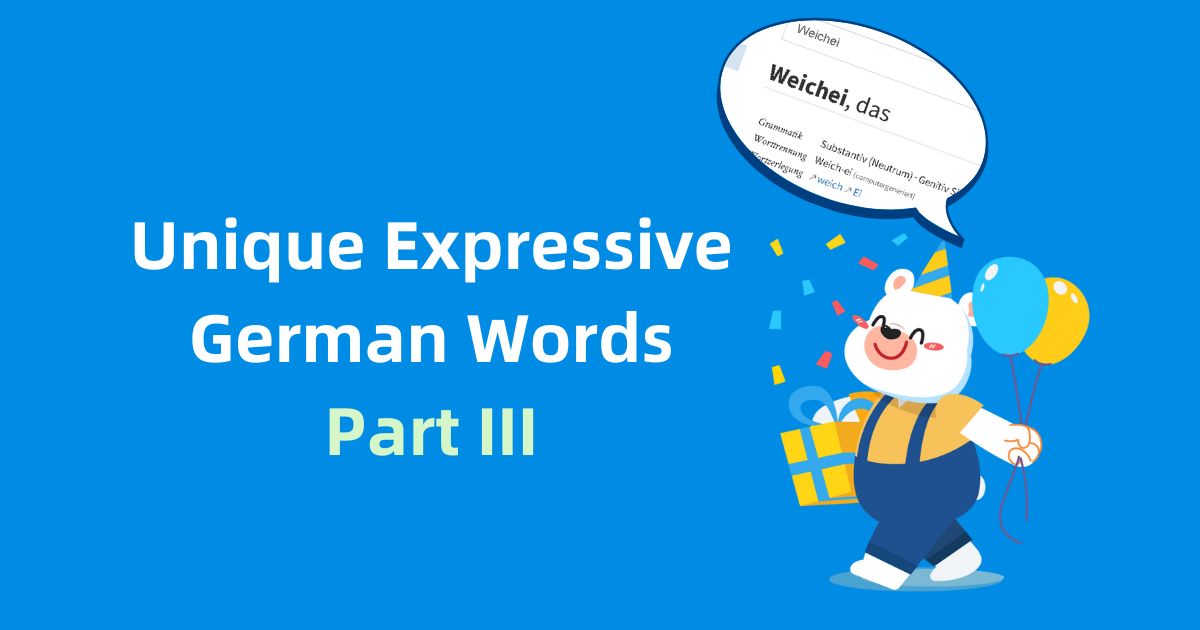
Welcome back to the “Unique Expressive German Words” series! Did you enjoy our earlier posts (Part 1 and Part 2)? Part 3 is now here!
In this post, you’ll get another glimpse into the fascinating world of the German language. You will discover more unique and expressive words. These words capture complex emotions and situations. Let’s continue this fascinating language journey together!
Weichei- Soft Egg
The word “Weichei,” literally translates to “soft egg,” is a slang term used to describe someone who is seen as weak, cowardly, or not tough. It paints a vivid picture of a person who, like a soft egg, is easily broken or lacking in strength. This playful yet somewhat critical term is often used in a teasing manner.
Example:
- Er ist so ein Weichei, er traut sich nichts.
- He’s such a wimp; he doesn’t dare do anything.

Quatschkopf — Nonsense Head
The term “Quatschkopf” is a playful and somewhat affectionate way to describe someone who talks a lot of nonsense or silly things. It is often used to gently tease a person who is saying something frivolous or not entirely sensible. The term “Quatschkopf” adds a light-hearted touch to conversations. When used directly, it’s typically meant in a friendly, teasing manner. However, if someone uses it behind another person’s back, it can carry more negative connotations. This situation suggests a less flattering view of the person’s chatter.
Example:
- Hör auf, so ein Quatschkopf zu sein!
- Stop being such a nonsense head!
Backpfeifengesicht – Slap Face
Have you ever heard the English proverb “A face only a mother could love,” which suggests that someone appears unappealing or obnoxious? In German, the equivalent expression is “Backpfeifengesicht,” referring to someone whose face inspire an urge to slap them. This term humorously describes a person who, through arrogance or irritating behavior, seems to invite such a reaction. While it’s not meant to be taken literally, it vividly conveys a sense of annoyance.
Example:
- Sein arrogantes Grinsen macht ihn zu einem Backpfeifengesicht.
- His smug grin makes him a face that needs a slap.
Drahtesel – Wire Donkey
“Drahtesel,” literally meaning “wire donkey,” is a quirky, colloquial term for a bicycle. The term cleverly combines “Draht,” referring to the bike’s steel frame, and “Esel,” symbolizing its functionality and durability. This charming nickname emphasizes the practicality and endurance of the bicycle, much like a donkey that carries loads. It’s a playful way to refer to this common mode of transport, highlighting its humble yet reliable nature. In everyday conversation, “Drahtesel” offers a fun alternative to the more formal “Fahrrad.”
Example:
- Ich nehme meinen Drahtesel zur Arbeit.
- I take my bike to work.

Schnapsidee – Schnapps Idea
Imagine this: one evening, after a few drinks, you slam your hand on the table and declare, “I’m not going to work tomorrow! We’re going to Iceland!” This kind of spontaneous, unrealistic idea is perfectly captured by the German term “Schnapsidee.” It describes a notion that seems brilliant when you’re tipsy but often turns out to be foolish or impractical. “Schnapsidee” is a humorous way to refer to those half-baked plans or wild suggestions that come from a moment of inebriated inspiration.
Example:
- Das war wohl eine Schnapsidee, um Mitternacht schwimmen zu gehen.
- That was probably a bad idea to go swimming at midnight.
Wasserhahn – Water Rooster
It’s pretty clear that chickens don’t exactly like to go swimming, right? Yet, the German term “Wasserhahn” literally translates to “water rooster.” Surprisingly, it actually means faucet or tap. This quirky term cleverly mirrors the role of a faucet, which controls the flow of water, much like a rooster heralds the start of the day. So next time you turn on the tap, just imagine it crowing to announce a refreshing stream of water!
Example:
- Dreh den Wasserhahn zu, bevor du gehst.
- Turn off the tap before you go.

Fremdschämen – Foreign Shame
The term “fremdschämen” perfectly captures that cringe-worthy feeling of being embarrassed for someone else, especially when they don’t seem to realize they should be. This compound word blends “fremd” (foreign) with “schämen” (to be ashamed). It highlights the awkwardness of witnessing someone’s embarrassing behavior from the sidelines. It’s that uncomfortable second-hand embarrassment you experience when someone else is making a scene and you’re left squirming on their behalf.
Example:
- Ich habe mich fremdgeschämt, als er das peinliche Lied gesungen hat.
- I felt embarrassed for him when he sang that embarrassing song.
And One More Thing….
If you’re eager to explore more interesting German expressions, we’re here! Download the FluenDay app for free and start your German journey today!


Leave your comments